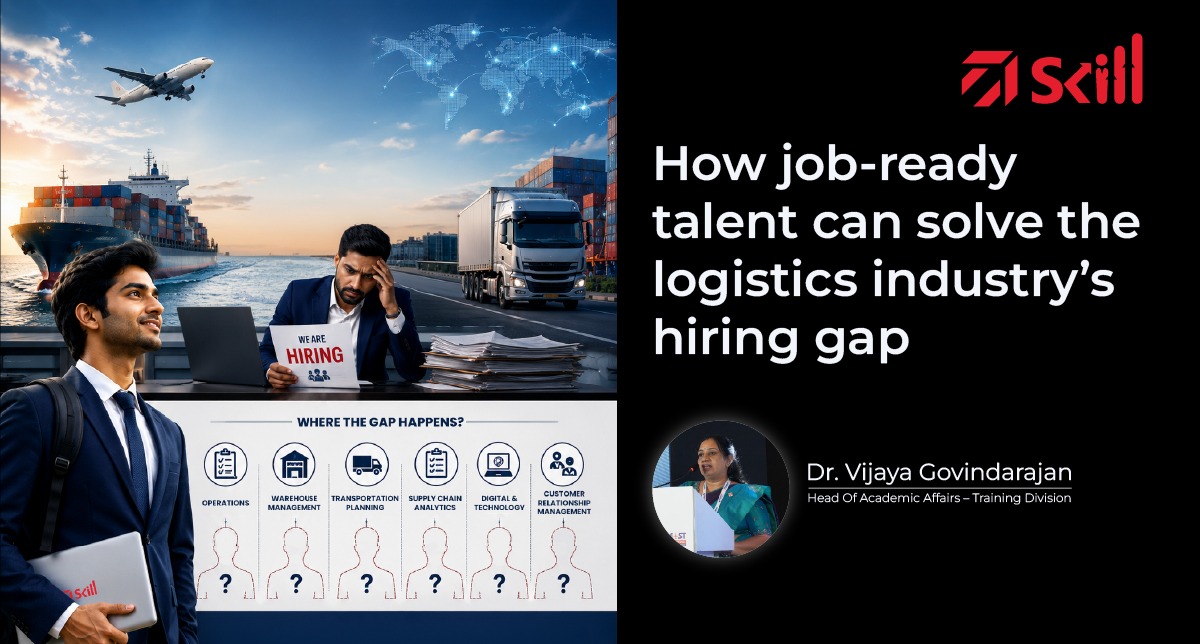
Every year, thousands of students graduate with aspirations of building meaningful careers.
At the same time, logistics companies, supply chain firms, air cargo operators, warehouses, e-commerce businesses, and quick commerce platforms continue to say the same thing:
“We cannot find job-ready talent.”
The irony is striking.
We do not have a shortage of students.
We do not have a shortage of jobs.
What we have is a shortage of industry readiness.
As someone working closely with employers, institutions, and learners, I believe placement is not something that should begin after a course is completed. It should begin on the very first day of learning.
The logistics industry today is no longer limited to moving goods from one place to another. It is powered by technology, analytics, automation, customer experience, compliance, sustainability, and real-time decision-making.
Employers are looking for candidates who can:
* Understand supply chain operations
* Work with digital tools and data
* Communicate professionally
* Solve operational problems
* Adapt to fast-changing business environments
* Learn continuously on the job
Unfortunately, many students still graduate without exposure to these realities.
This is where placement cells and skilling institutions must work differently.
Instead of treating placements as an end-stage activity, we must build an ecosystem that integrates:
* Industry projects
* Internships and OJT opportunities
* Employer interactions
* Real-world case studies
* Career readiness training
* Industry-recognised certifications
At TT Skill, this has been one of our key focus areas.
Our objective is not simply to train learners.
Our objective is to help learners become employable, industry-ready professionals who can contribute from Day One.
The logistics sector alone is expected to create significant opportunities across warehousing, transportation, e-commerce, air cargo, freight forwarding, inventory management, supply chain analytics, and emerging technology-driven roles.
The opportunity is enormous.
The responsibility is shared.
Placement cells, institutions, industry partners, and skilling organisations must work together to bridge the gap between education and employment.
Employers, too, have an important role to play by engaging early with learners and helping institutions align training with real workplace expectations.
Because ultimately, successful placements are not measured by how many students receive offer letters.
They are measured by how many careers are built sustainably.
The future of logistics belongs to skilled, adaptable, and industry-ready professionals.
Let us work together to create them.